• Do you know how important music is? It really isn’t anything we think about often, but it is so ridiculously in our lives. For example, I’m listening to music while writing this, and I wouldn’t have even realized if I wasn’t talking about music itself. I find myself listening to music when doing anything really: walking to class, doing work, eating, cleaning, legit anything. And from talking to my peers and the people around me, they feel the exact same way.

    For my final article, I intend to talk about this exactly. Going into detail on why and how music is so important. In addition to this, I intend on learning about how the music we listened to growing up impacts what we currently listening too. This is something I’ve been very intrested just based on the music my friends and I listen to. For example, my mom listens to 70s and 80s pop-rock, and my dad listens to more 90s rock and roll and hip hop. I am very cruious on how this alignes to what I listen to and how it relates to my peers.

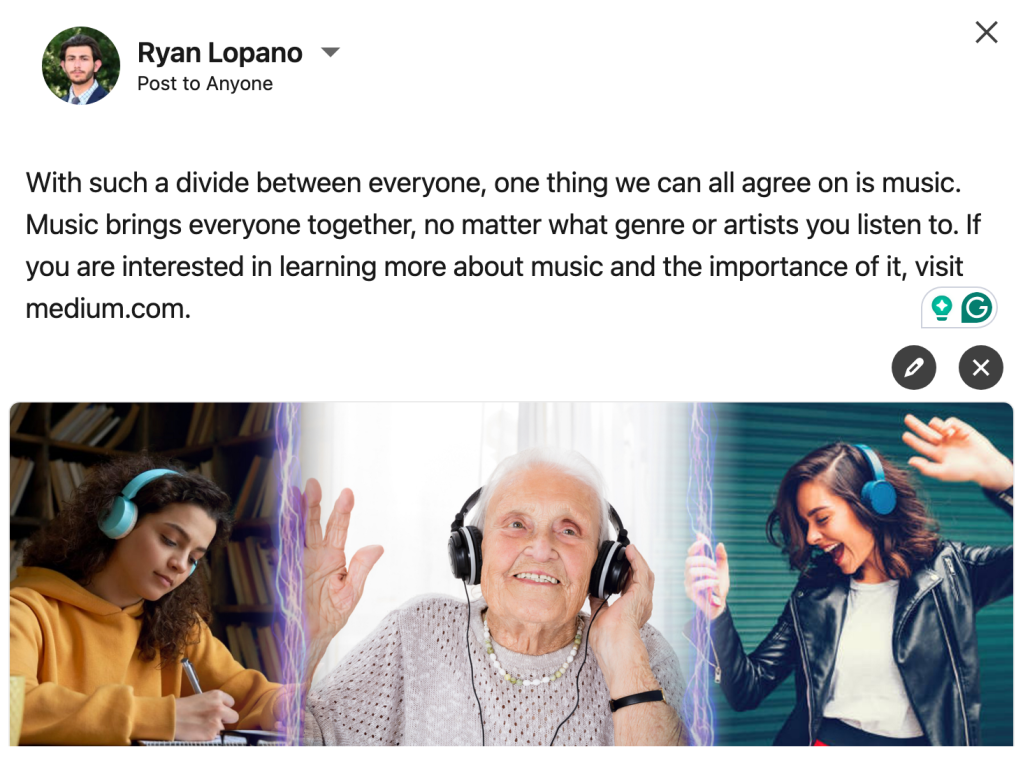
    Marketing is very important when it comes to online articles. I know I constantly scroll through LinkedIn and see advertising for articles, businesses, and other professional ventures. Talking about LinkedIn, I plan on using the article image photo as my main marketing piece. I want to do so in order to build brand equity and build familiarity with it. Shown below is an image that can and might be used in my final article.
    For Instagram and X, it is important to have more eye-catching images and graphics. For Instagram, I would make a sliding photo album showing many artists, which eventually leads to the article advertisement. I would also take advantage of the music feature on Instagram and add a few songs to the photo album. This would tie it back to the article with the music theme. For X, I would do something very similar but only using one photo. I find that one photo is more effective and generally looks better than the limited four that X allows you to use. Examples of both of these are below.


  • When you are writing, there is a clear difference between writing for a quick skim through from the eye versus reading it outloud for many to hear. Personally, when I am writing for reading internally, it is filled with much more context and details, as you don’t have the verbal inflections to go off of. Zinser mentions that, “Verbs are the most important of all your tools. in Chapter 10.” Giving this context, through verbs and other ways of speech, is important because it isn’t always obvious, and you need to let the writing do the heavy lifting.

    You need to make sure that when a reader is going over your work, it is easy to tell the context. According to Zinser, “Writing that will endure tends to consist of words that are short and strong.” These strong words are really important when you aren’t audibly reading work. The words need to have an important meaning as they are the only thing the reader has to go off of. That is why it is important to include these when writing for internal reading.

    Reading outloud doesn’t have this issue. You have the ability to hear and see what the reader wants you to see, so this gives you all the information you need to know. One disadvantage of listening to work out loud is that you don’t have the ability to go back. Because of this, it is important to absorb all the important information and try to understand everything that is being said. When giving speeches, you want to make sure you speak strongly so the listeners understand everything you are talking about and take it as intended.

    Both reading and listening have their positives and negatives. It is really based on personal preference, but both are important. Knowing how to write both is very useful, and adding extra details based on which one you are writing for is very useful.

  • Context is the invisible force that shapes how readers understand information. Words do not exist in isolation; they arrive surrounded by tone, timing, framing, and expectation. A sentence that feels neutral in one setting can feel persuasive, misleading, or even dangerous in another. This is why context matters just as much as content.

    In media and writing, context is built through selection. What comes first, what is emphasized, and what is left out all guide interpretation. A statistic placed after an emotional anecdote feels different than the same statistic presented alone. A headline can prime a reader to feel anger or trust before they even reach the body of an article. These choices are rarely accidental. They are tools writers use—consciously or not—to steer understanding.

    Context also relies heavily on audience assumptions. Writers often anticipate what a reader already believes and build around it. When an article aligns with a reader’s expectations, it feels “obvious” or “true,” even if opposing information exists elsewhere. This is how framing works: by narrowing the lens, writers can make one interpretation seem natural and others seem unreasonable.

    Timing plays a role as well. Information released during a crisis is read differently from the same information shared during calm conditions. Urgency compresses critical thinking, while familiarity breeds acceptance. Over time, repeated framing becomes normalized, and readers stop questioning it altogether. At that point, context stops feeling like context and starts feeling like reality.

    None of this means context is inherently unethical. Context is necessary for clarity. Without it, information becomes fragmented and meaningless. The ethical line appears when context is used to conceal complexity rather than explain it—when framing replaces truth instead of supporting it.

    For readers, understanding context is a form of literacy. Asking what is missing, why something is emphasized, and who benefits from a particular framing restores agency. For writers, being aware of context is a responsibility. Meaning is not just written; it is constructed. And often, what surrounds the message matters more than the message itself.

  • Context is the most important thing in writing. If you do not give the reader context, they will not understand what is going on. Giving context is like giving vision to someone who can’t see; it’s ridiculously important. According to American painter Kenneth Noland, “Context is the key; from that comes the understanding of everything.” This shows how important context is. Without it, no one understands what you are talking about.

    Context is ridiculously important when it comes to blog posts. When you are writing blogs, you have zero idea who is reading them. That is why it is so imporant why you add context to your writing. Adding quotes and other sources helps give context to the people who don’t fully understand what is going on. I have used hyperlinks and other sources plenty of times to understand what writting is talking about and to give more understanding than the original reading has.

    Without context, you can really manipulate the perspective of the reader. Famous writer, Mark Twain, talks about how “a lie can travel halfway around the world while the truth is still putting on its shoes.” I think this is very telling, as it shows that misinformation can lead to widespread manipulation of people. When reading articles and other publications, it is very easy to find misinformation or platform who are trying to twist the truth. That is why it is super important when reading things like that to fact-check and make sure all the information is correct, and to make sure everything you are reading is factual. Going back and using common sense is ridiculously important.

    All in all, using context is super important when reading an article you are unfimiliar about. You want to make sure that the article is factual and that you use all your sources to look back and make sure all the information is correct. According to Rudyard Kipling, “Words are the most powerful drug used by mankind.”

  • When going through different articles, you can definitly seem a divide between the people who are actual writers and people who aren’t. Even as someone who doesn’t consider himself a writer, it still seems pretty clear who knows their stuff. A big part of this is who the writing is actually targeted to. I find that more experienced writers tend to gear their articles towards the reader themselves. I compare this to less experienced writers who sometimes lack detail and don’t give context to their articles.

    Someone who doesn’t agree with my philosophy is William Zinsser. He talks about how important it is to write for yourself. He specifically says, “There is no such audience; every reader is a different person,” in Chapter 5. I don’t fully disagree with this, but I do find more value in writing towards the writer. I think it leads to a better overall experience.

    Going deeper into Zinsser’s philosophy, he talks about how “Editors and readers don’t know what they want to read until they read it. Besides, they’re always looking for something new.” I definitely understand what he is getting at. I think a good analogy to this is when people say they have trouble picking something to watch on Netflix or other streaming services due to there being so many options. I believe Zinsser would think that would be the same thing when it comes to writing. It is difficult to pick an article with the number of options that are out there. In addition, the audience isn’t experts and doesn’t truly know what they want.

    I feel like this brings me back to my point of the difference between writing for your audience versus yourself. When you are writing to a smaller audience or to yourself, you leave out details and don’t need to deal with people “not knowing what they want.” This definitely isn’t the case when you expand the audience. In addition to an increase in audience, you increase the reach. With this, you need to adjust your writing to match and fit what is expected.

  • Ryan Lopano is a 3+1 Graphic and Interactive Design student at Quinnipiac University, who minors in Advertising/PR and Social Media Strategy. Being in the 3+1 program, Ryan will continue his journey at Quinnipiac University in the Interactive Media and Communications program this summer. At Quinnipiac, Ryan is a member of Qunnipiac Bobcats Sports Network and is the Lead Designer of the Magazine. Under him, they have produced five magazines in three semesters. In the fall of 2025, he was a member of The Agency, Quinnipiac’s student-run agency. While at The Agency, he was the Vice-President of Graphic Design.

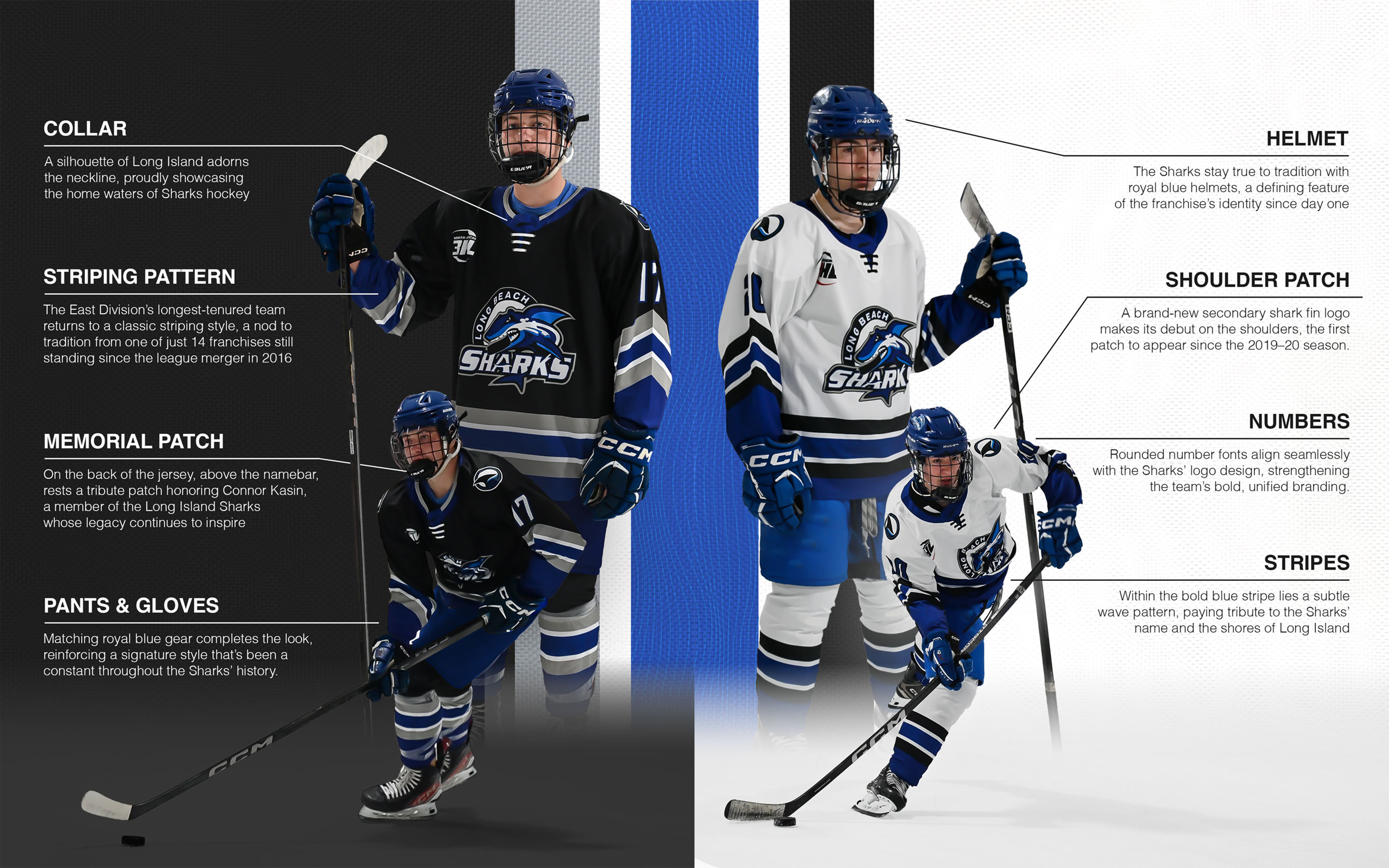
    Outside of Quinnipiac, Ryan works on graphic design and social media management for the Oklahoma Warriors and the Long Beach Sharks. He has worked for these two junior hockey teams for two and four years, respectively. In addition, he recently started an internship with the Brampton Steelheads this January. One of his favorite projects he has done comes from one of these teams. Specifically, he redesigned the jerseys for the Long Beach Sharks. Seeing these jerseys on ice is very rewarding for him, and adding small details was his favorite part of that project. These details can be seen below and include the silhouette of Long Island in the collar, a wave pattern within the stripes, and increased visibility, which was an issue with the previous uniforms.


    In the future, Ryan aspires to continue his work in hockey and eventually pursue a career with the NHL. His favorite team is the New York Rangers, so he would love to work for them or any of the other 31 teams in the league. His experience with opportunities through Quinnipiac and the hockey teams he has worked for has guided him to where he is today. He hopes to eventually work up the ranks and eventually end up being in the sports design field.

  • Going through this Module, I learned a lesson that was very important. Peer review is way more important than it seems. As someone who doesn’t use this as much as I should, going back and seeing feedback is very valuable.

    According to Washington and Lee University, “Users engage more with content that includes clear headings, bullet points, and short paragraphs, because these elements help them locate information quickly.” This is something that is harder to see in your work than it is in others. That’s why it is important to get feedback from others. In both assignments, I got very valuable information that I wouldn’t have thought of by just proofreading. Getting others’ opinions is very valuable.

    One example from the feedback I got was the importance of hyperlinks. This is something I haven’t thought about, but it is definitely very important. This gives readers context and lets them understand what you are talking about. I am lucky for the peer feedback because that is how I got the idea to include it in my writing.

    Another piece of information I learned from the peer feedback is the practice of removing fluff. For all of my life, I’ve been told to write with detail and include as many details as I can. This was contradicted in the feedback I got. I was told to limit this and get to the point directly. This is also backed up in the reading, as it says, “People rarely read Web pages word by word; instead, they scan the page, picking out individual words and sentences” (Nielsen).

    Overall, all of the real-life examples have shown me how important peer review really is. Going through my reading before and after the peer review is really night and day. In addition, I have reading to back up this argument. I am lucky to have people to look over my work and give such professional feedback on it.

  • For my white paper, I decided to focus on the effectiveness of the National Hockey League’s marketing. If you know anything about hockey, you know that the NHL doesn’t do the best job of marketing itself outside of the hockey bubble. The league knows how to engage fans once they already like hockey, but it struggles to convert other sports fans into hockey fans. It’s a shame because hockey is such a fast-paced sport filled with exciting goals and massive hits. If the league did a better job of getting new eyes on the game, I can almost guarantee those viewers would stick around.
    Because of this, my paper discusses all the ways the NHL could improve its marketing efforts. For starters, I believe it’s important for the league to focus on younger generations. There’s a wave of young players entering the NHL who are very relatable to today’s youth hockey players. These new players can also attract new fans with their creative styles of play. In addition, the NHL needs to capitalize on its major events. Last season, the league had a great opportunity with the Four Nations Faceoff, and it has a similar opportunity this year with the upcoming Winter Olympics. These are perfect chances to get people engaged and rooting for their countries.
    Overall, there’s a lot the NHL can do to market itself better. Hopefully, some of these ideas can actually come to fruition, as I would love to see my favorite sport continue to grow.

    Because of this, the paper talks about all the things the NHL could be doing better. For starters, I believe it’s important for the league to focus on the younger generation. There is a wave of young players coming into the league that are very relatable to the young hockey players of today. In addition, these new players can attract new fans with there more abstract style of play.

  • Having stress take over can be a huge motivation killer. I just had this happen to me the other day. When you have too much going on, it can really take over and make you not want to do anything. It is really a problem because once you lose motivation, all bets are off. It is really a problem as it really stops you from doing most things productively. Johann Hari says, “The number-one reason… for their [attentional] problems… was stress” in Chapter 10. Because of this, it is really important to rest.

    After having all of this time, it is important to take time for yourself and rest. You don’t need to necessarily go to sleep, but it is important to relax. Chapter 11 of Stolen Focus: Why You Can’t Pay Attention states, “Your brain doesn’t necessarily switch off as easily if you’re going, going, going. You don’t take that time to switch off and relax… Your brain becomes accustomed to thinking constantly.” This means that taking time to just turn off our brains is really crucial. Good ways to relax are taking a shower or bath, laying down and watching a favprote show or movie, or even just turning off the lights and going to sleep are good ways to relax. Just taking time to drown out the noise and just focus on yourself is really crucial.

    Realistically, if you don’t do anything in regards to resting, it won’t benefit you. Hari mentions in Chapter 11 that, “As you become tired, your attention will indeed blink out … even if your eyes are open and you are looking around you, you can lapse … into a state called ‘local sleep.” Local sleep is basically your mind going numb. There are a bunch of things going on, and you don’t know what to do or what to focus on. That is why it is so important to rest. Without it, you are setting yourself up for failure and could potentially make it so that less stuff gets done.

    Something specific that Hari talked about is financial stress. Obviously, worrying about money is going to take a toll on your stress. Stolen Focus talks about “If you have to worry about your financial situation … it takes a lot of the capacity of your brain. If you don’t have to worry, then it improves your capacity to think about other things.” This makes total sense, as financial issues will put a halt to anything you are doing. If you any bit of what you are doing is paused because of money, this can really demotivate you and make it impossible to get other things done.

    All and all, it seems that getting rest is very crucial to preventing stress levels from getting high. By taking control over everything going on, you can manage your time better and lessen the amount you have going on at once. After that, you can get proper rest that helps everything else.

  • According to Mindmapping.com, a mind map is a “diagram for representing tasks, words, concepts, or items linked to and arranged around a central concept or subject using a non-linear graphical layout that allows the user to build an intuitive framework around a central concept.” Personally, whenever I see a mind map, I always think of a detective’s board, where it has the spider web of string connecting everything, but in reality, that is kind of what it is. It is a way to take a bunch of related ideas and bring them together. Something else that makes me think of mind maps is a Prezi presentation. You can zoom it back super far, and it gives off the same idea of a mind map. Regardless, mind maps are very useful for many purposes.

    It seems like a really good way to just get ideas onto paper, then they could get organized into subcategories. I can see this being super useful in graphic design when creating a brand identity. If you take a bunch of words and images that your client likes and relates to, you can stick them on one mind map and connect them all together. This makes total sense as a Psychology Author and Television Presenter, Tony Buzan, was the one to come up with the term mind map, according to The Interaction Design Foundation. It goes on to talk about how “in user experience (UX) design, effective organization and a clear understanding of information are nothing short of vital for any digital product to succeed. Sure enough, designers and design teams depend on this clarity to help create user-friendly products and services.” This is definitely useful to someone who has a designer mind, as looking at ideas and concepts more visually is definitely very useful.

    Something else that mind maps seem like they could be useful for is formulating ideas for an essay. It could be a step before writing an outline as an informal way to get your ideas onto paper. Depending on how you write and how your brain works, this can definitely be helpful. I have never tried this, but I really wouldn’t be opposed to the idea. Overall, it could be a good step to dive into a longer essay, just like the white paper we need to write. According to the Graduate College at Illinois, “The key of mind mapping is that it allows a writer flexibility while discouraging us from thinking too much about the phrasing, layout, and sentence-level structure of our ideas.” This basically confirms my point, showing that mind maps are good at laying out ideas before you have even thought about writing your paper or your outline.

    Despite being unfamiliar at first, it seems like mind maps are an underrated tool in our everyday lives. From being useful in academic settings, like writing a paper, or in a more professional setting, like helping clients create brand identities and other designs, they seem very practical.